Almost every turn comes down to one idea: turning traffic gives way to traffic that isn't turning. The rest is about doing it in the right order — check, signal, position, check again, then turn when it's safe.
The basic move
For any left or right turn, check in front, behind and to the sides, and glance over your shoulder for the blind spot. Watch for pedestrians, signal for at least 3 seconds (left indicator to go left, right to go right), and turn only when it's safe. If another driver should give way to you but hasn't, be ready to stop anyway — being right is no comfort after a crash.
Turning left
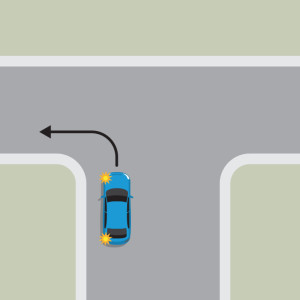
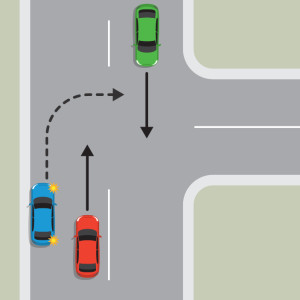
Keep left as you approach, slow down, check your mirrors and your left-shoulder blind spot, signal at least 3 seconds, and turn when safe. Hold your road position through the turn: if you were on the left before, stay left after.
Turning right
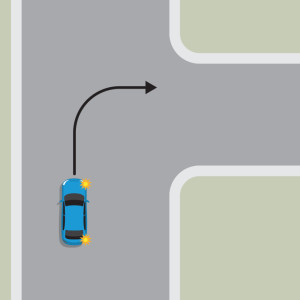
On a road with a centre line, slow down, check your mirrors and right-shoulder blind spot, signal at least 3 seconds, and move towards the centre line to position for the turn. Check the mirror and blind spot again, then turn when safe — into the lane next to the centre line if the road has lanes.
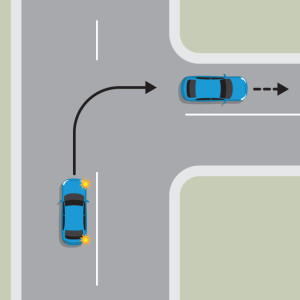
Where traffic is fast or close, or the road is narrow, it can be safer to wait on the left instead of the middle: signal left for 3 seconds, move to the left side, wait for a gap, then signal right for 3 seconds, check your blind spot and go. If a vehicle ahead has also stopped to turn right, wait behind and turn from the same spot. While you wait, keep your wheels pointed straight ahead — that way a rear-end knock won't shove you into oncoming traffic.
Right-turn bays and flush medians
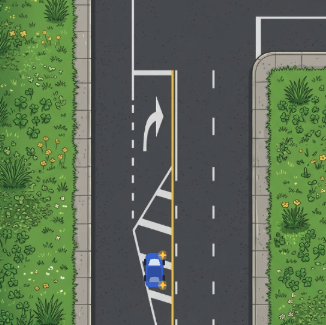
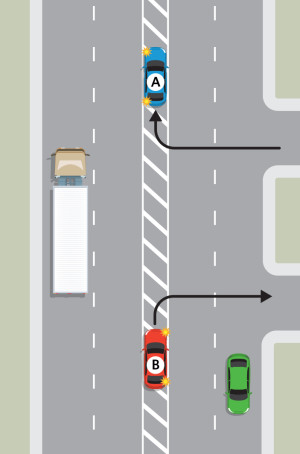
A right-turn bay (a white triangle and diagonal lines leading to right-turn arrows) lets you wait to turn without holding up through traffic. You may cross its diagonal lines only to turn right — not to overtake a straight-ahead vehicle. A flush median (white diagonals between parallel lines) may be entered only to wait for a gap, either after turning right onto the road or before turning right off it; watch for pedestrians who may be waiting there too.
Turning from a driveway
Coming out of a driveway you give way to everything. Slow to a complete stop at the end, check the road and footpath, and give way to anyone on the footpath, cyclists on a cycle path or lane, and all vehicles on the road — including a vehicle turning right into the same driveway.
U-turns and crossing a no-passing line
A U-turn is normally allowed when the road is clear both ways, it's safe, and you have room — but not on a motorway or where a No U-turn sign is displayed. Turning into a driveway or side road, you may cross a solid yellow no-passing line if it's safe, but take extra care where your view is limited, or turn further along where you can see better.