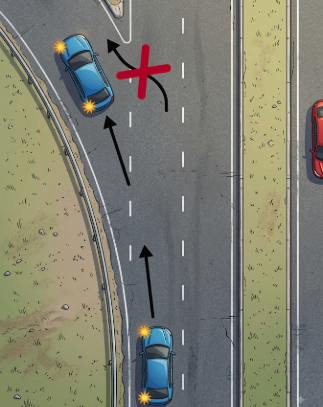
Merging works best when everyone treats it like a zip. The rules cover the three places you merge: where two lanes become one, a merge lane at an intersection, and motorway on- and off-ramps.
Merge like a zip
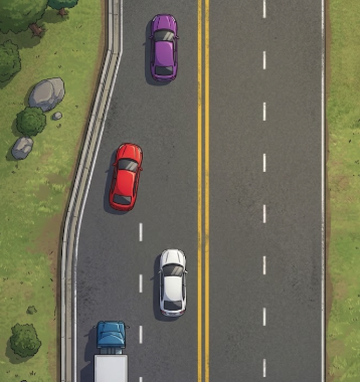
Where two lanes merge into one — at the point the broken lane lines stop — merge like a zip: let one vehicle from the other lane go, then you go, alternating, so every vehicle has space. No pushing in, no racing to the front.
Merge lanes at intersections
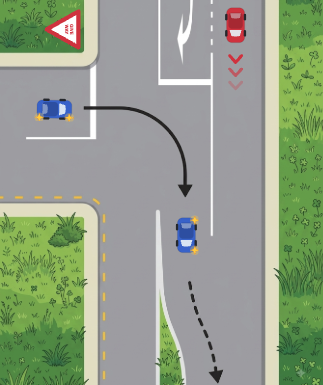
In a merge lane after turning onto a road at an intersection, signal to merge for at least 3 seconds, move into a safe gap, and adjust your speed and following distance to fit the flow.
Motorway on-ramps
Entering a motorway, use the whole length of the on-ramp to match the speed of the traffic — no sudden speed change. Signal right for at least 3 seconds and move into a safe gap without entering at a sharp angle, then settle your speed and following distance.
Motorway off-ramps
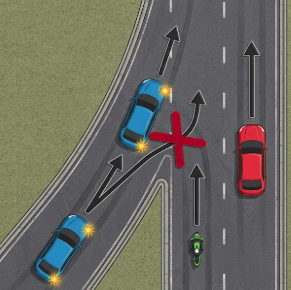
Leaving a motorway, watch for the exit signs, signal left for at least 3 seconds, and move into the left lane as early as you can. Keep up with the traffic flow until you're on the off-ramp itself — don't peel off at a sharp angle — then adjust your speed. If you miss the exit, carry on to the next one rather than braking or swerving.