Most rear-end crashes come down to following too closely. A good gap gives you time to react and stop, and a clearer view of what's happening up ahead. The two- and four-second rules make it easy to judge at any speed.
Why the gap matters
Keep a safe following distance so you have time to stop suddenly and can see hazards developing further ahead. Stopping always takes several seconds — your reaction time plus your braking time — so the faster you go, the more distance you need. Increase your gap whenever you're tired or your reactions are slower than usual.
The two-second rule
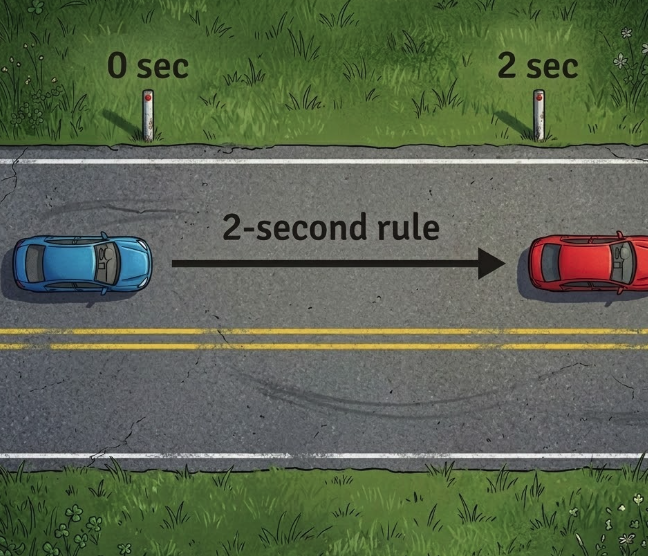
In normal conditions, use the two-second rule to keep a safe gap at any speed. When the vehicle ahead passes a fixed roadside landmark, count "one thousand and one, one thousand and two". If you reach the landmark before you finish counting, you're too close — ease back and try again.
The four-second rule
In bad weather, on a wet or slippery road, or when towing a trailer, double it — use the four-second rule, counting to "one thousand and four".
Letting others past, and being tailgated
If you're following a vehicle you don't intend to overtake, leave enough space ahead for vehicles behind to pass. And if someone is tailgating you, slow down and open your own gap to four seconds — then move left to let them past when it's safe.