At an intersection, the give way rules decide who goes first. The idea behind them is simple — if your path would cross someone else's, work out who has to wait — but a handful of specific situations trip people up. Here's the whole picture.
What "giving way" actually means
Giving way means letting the other road user go first, and doing it early enough that they never have to stop, brake, slow down, swerve or take any evasive action because of you. If they had to react to avoid you, you didn't really give way — you just got in the way.
Turning
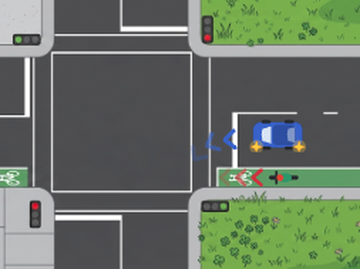
The one rule that covers most situations: if you're turning, give way to traffic that isn't turning. That includes more than the cars in the main lane — you also give way to cyclists riding straight ahead in a cycle lane, and to vehicles continuing straight in a bus lane.
Turning right is where most give-way mistakes happen, because your path cuts straight across the oncoming lane. When you're turning right and an oncoming vehicle is either going straight through or turning left, you give way to it — and that applies whenever you both face no signs or signals, or the same ones.
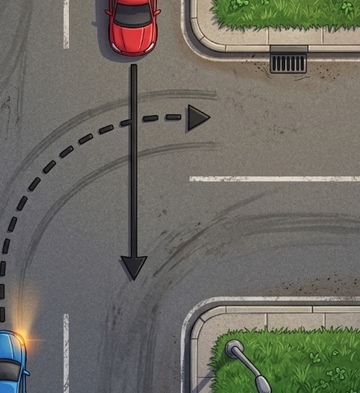
There's one neat exception. When two oncoming vehicles both want to turn right, their paths don't actually cross, so neither has to give way to the other — but a right-turner still gives way to an oncoming vehicle turning left.
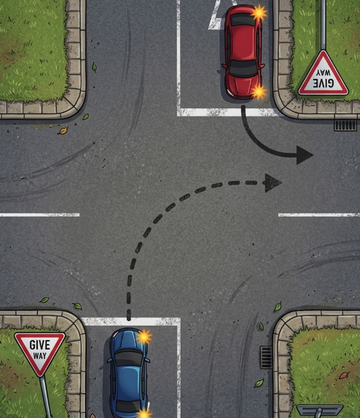
The centre-line catch
At an uncontrolled intersection, watch the centre line. If you leave the path of a marked centre line — even if you'd say you were "going straight" — you count as turning, and must give way to vehicles that are following that line.
T-intersections and driveways
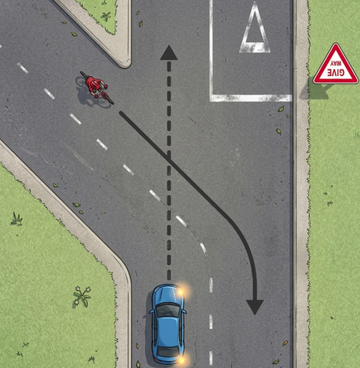
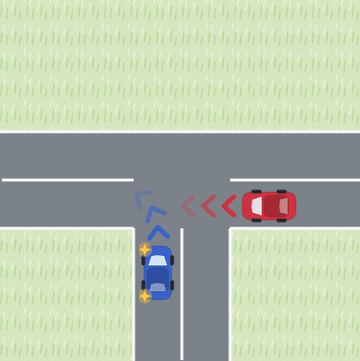
At a T-intersection, traffic on the road that ends (the bottom of the T) gives way to all traffic on the road that continues (the top of the T).
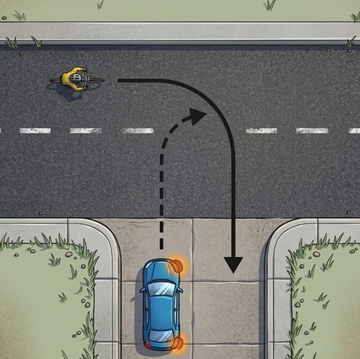
Pulling out of a driveway, you give way to everything: all traffic on the road, plus anyone on a footpath, cycle path or shared path that you cross on the way out.
Roundabouts and uncontrolled intersections: give way to your right
For anything the specific rules above don't cover — a roundabout, an uncontrolled crossroad, or an intersection whose signals have failed and are flashing yellow on every approach — there's one simple fallback: give way to everything coming from your right.
Traffic signals
The lights themselves are straightforward — red means stop, green means go if it's safe. But two things catch people out on a green:
- Turning right on a green light, you still give way to oncoming vehicles going straight or turning left.
- On any green, give way to pedestrians who are crossing — including people using mobility scooters or wheeled recreational devices.
A yellow light means stop, unless you're already too close to pull up safely. A flashing yellow means the signals aren't working — so fall back on the ordinary give way rules.
Arrow signals
An arrow only applies to vehicles heading in the arrow's direction — if you're not going that way, it isn't talking to you. When you are: a red arrow means stop, a yellow arrow means stop (unless you're too close to stop safely), and a green arrow means go if it's safe.
Combined (six-light) signals
Some intersections pair a round light with a left- or right-turn arrow, so different movements get different instructions at the same time. Read across the row for your movement:
| Lights showing | Turning left | Going straight | Turning right |
|---|---|---|---|
| Red left-arrow + green round | Stop (the arrow protects crossing pedestrians) | Go if safe | Go if safe — give way to oncoming straight-through and left-turning traffic |
| Yellow right-arrow + green round | Go if safe | Go if safe | Stop, unless it isn't safe to stop |
| Green right-arrow + green round | Go if safe | Go if safe | Go if safe (oncoming and left-turning traffic should be stopped) |
| Green right-arrow + red round | Stop | Stop | Go if safe (oncoming and left-turning traffic should be stopped) |
Cycle, tram and bus lane signals
When special cycle, tram or bus lane signals are showing, those vehicles may move while everyone else waits for the normal green. And if you're a cyclist, moped or motorcycle rider lawfully using a bus lane, a white B light is your signal to go.