Roundabouts have one core give-way rule and one signalling routine. Get those two right and the rest is just staying in the correct lane and keeping an eye on bigger, faster vehicles.
The give-way rule
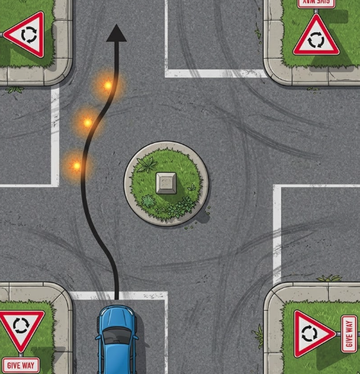
At every roundabout you travel to the left of the central island, and as you enter you give way to all vehicles crossing your path from your right. Approaching a single-laned roundabout, slow down, be ready to give way, and yield to traffic from your right. At a multi-laned roundabout it's the same, plus you must already be in the correct lane — follow the lane markings and arrows before you reach it. If you need to change lanes to reach your exit, give way to any vehicle already in the lane you want, and take extra care near the exits.
Signalling
Where you're going decides how you signal:
- Turning left (first exit): signal left as you come up to the roundabout.
- Going straight through: don't signal on approach; signal left as you pass the exit before the one you want.
- Turning right (more than halfway around): signal right as you approach, then switch to a left signal as you pass the exit before yours.
Cyclists are exempt from the signalling rule — holding out a turn signal on a roundabout can be hard to do safely — so don't expect a hand signal from a rider.
Signs and what to watch for
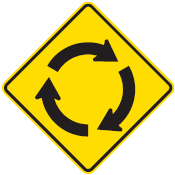
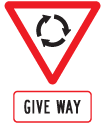
A "roundabout ahead" warning tells you to be ready to give way; a "keep left" sign means pass to the left of the traffic island; and a "give way at roundabout" sign is your reminder to apply the roundabout rules. Once you're on it, look out for vehicles changing lanes to exit, and for large vehicles like buses — or anyone going too fast — that can't hold their lane.