Cyclists are hard to see, easily hurt, and can be pushed off their line by things you might not notice — a pothole, a gust, an opening car door. Driving well around them is mostly about looking harder and leaving room.
Around and passing cyclists
Stay alert near cyclists: they're vulnerable, and hazards like parked cars, potholes, wind and opening doors can make them veer into your path. When you pass, give plenty of room — at least 1.5 m; on a narrow road, wait for a clear space first.
At intersections
Treat a cyclist like any other vehicle: indicate your turns and check carefully for riders before turning or moving through. If you're following a cyclist and want to turn left, wait until they've passed the intersection rather than cutting across them. At a busy intersection a cyclist may make a hook turn to turn right — going straight in the left lane and stopping on the left to wait for a gap or the signals.
Cycle lanes and your car door
Give way to cyclists before you cross a cycle lane. You must not drive in or cross a cycle lane except for up to 50 m when entering or leaving a side road, driveway or parking space, and you must never stop, stand or park in one. When you open your car door, check carefully for cyclists first, and open it with your left hand so your shoulders turn and you're more likely to see them. Check for cyclists too when reversing or pulling out of a driveway.
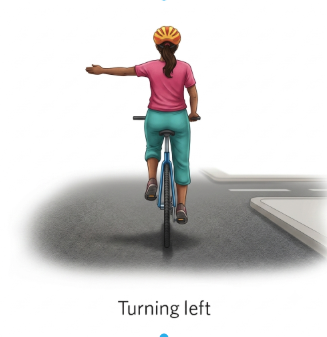
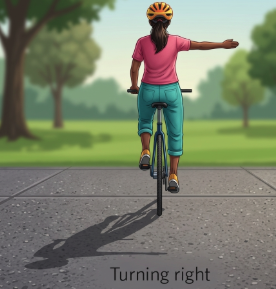
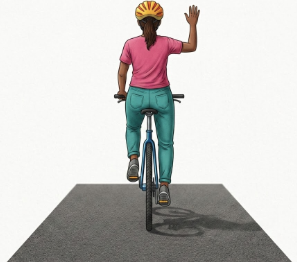
Cyclist hand signals
Riders signal with their arms — left arm out for a left turn, right arm out for a right turn, and right arm bent with the hand pointing up for stop.
Worth remembering
Cyclists may ride away from the kerb or take a lane to avoid drains, potholes and rubbish, to be seen at side roads, and to stop drivers squeezing dangerously past — they have a right to road space. At night, dip your headlights for cyclists too, since full beam dazzles them, and remember they're small, hard to see, and can travel at 40 km/h or more.